Test Bank For Vander’s Human Physiology 14th Edition ISBN 9781259294099 All Chapters Latest Update PDF Download
Course:
Homeostasis
Institution:
Homeostasis
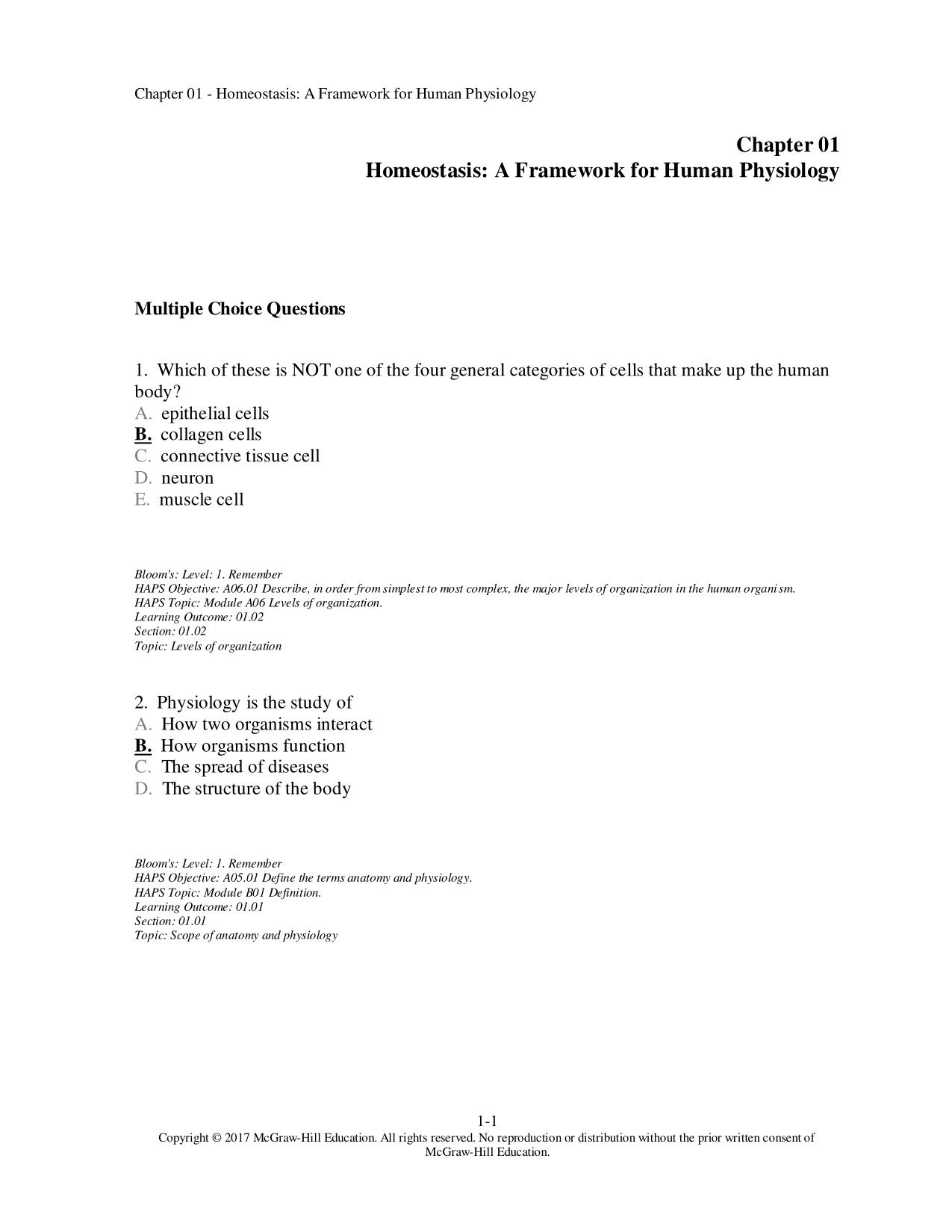
Multiple Choice Questions 1. Which of these is NOT one of the four general categories of cells that make up the human body? A. epithelial cells B. collagen cells C. connective tissue cell D. neuron E. muscle cell Bloom's: Level: 1. Remember HAPS Obje...
After purchase, you get:
✅ Instant PDF Download
✅ Verified answer explanations
✅ Refund if not Satisfied
✅ Prepared for 2025/2026 test cycle
Overview
This material encourages active engagement through solution walkthroughs that reinforce both theory and application. Rather than passively reading, you're constantly interacting with the content through problem-solving. This active learning approach makes study sessions more dynamic and information more memorable. Many learners find they retain knowledge better when they've worked through problems rather than just reviewed notes. Packed with methodical items and clear answer reasoning, Test Bank For Vander’s Human Physiology 14th Edition ISBN 9781259294099 All Chapters Latest Update PDF Download trains you to think like the examiners. You'll start recognizing patterns in how questions are constructed and what the test creators are really asking. This shift in perspective often leads to those "aha moments" where difficult concepts suddenly make sense. Many successful test-takers credit this approach with helping them navigate tricky questions that stump less-prepared candidates.
Who Is This For?
A recommended pick for anyone looking to review, reinforce, and excel at Exam (elaborations) exam topics using reliable practice content. Many educators suggest similar materials to their students. The trusted format has stood the test of time across multiple exam cycles. A strong fit for learners in Homeostasis looking to develop exam familiarity, question interpretation skills, and test-taking self-assurance. Students often share this resource with classmates during study groups. The practical approach has proven helpful across different learning styles.
Related Keywords
Detailed Study Description
Frequently Asked Questions
Document Information
| Uploaded on: | November 1, 2025 |
| Last updated: | November 17, 2025 |
| Number of pages: | 778 |
| Written in: | 2025/2026 |
| Type: | Exam (elaborations) |
| Contains: | Questions & Answers |
| Tags: | Multiple Choice Questions 1. Which of these is NOT one of the four general categories of cells that make up the human body? A. epithelial cells B. collagen cells C. connective tissue cell D. neuron E. muscle cell Bloom's: Level: 1. Remember HAPS Objective: A06.01 Describe, in order from simplest to most complex, the major levels of organization in the human organism. HAPS Topic: Module A06 Levels of organization. Learning Outcome: 01.02 Section: 01.02 Topic: Levels of organization 2. Physiology is the study of A. How two organisms interact B. How organisms function C. The spread of diseases D. The structure of the body Bloom's: Level: 1. Remember HAPS Objective: A05.01 Define the terms anatomy and physiology. HAPS Topic: Module B01 Definition. Learning Outcome: 01.01 Section: 01.01 Topic: Scope of anatomy and physiology |
Seller Information

AdelineJean
User Reviews (0)
Exam (Elaborations)
$17.00
Add to Cart
100% satisfaction guarantee
Refund Upon dissatisfaction
Immediately available after purchase
Available in Both online and PDF
$17.00
| 0 sold
Discover More resources
Inside The Document
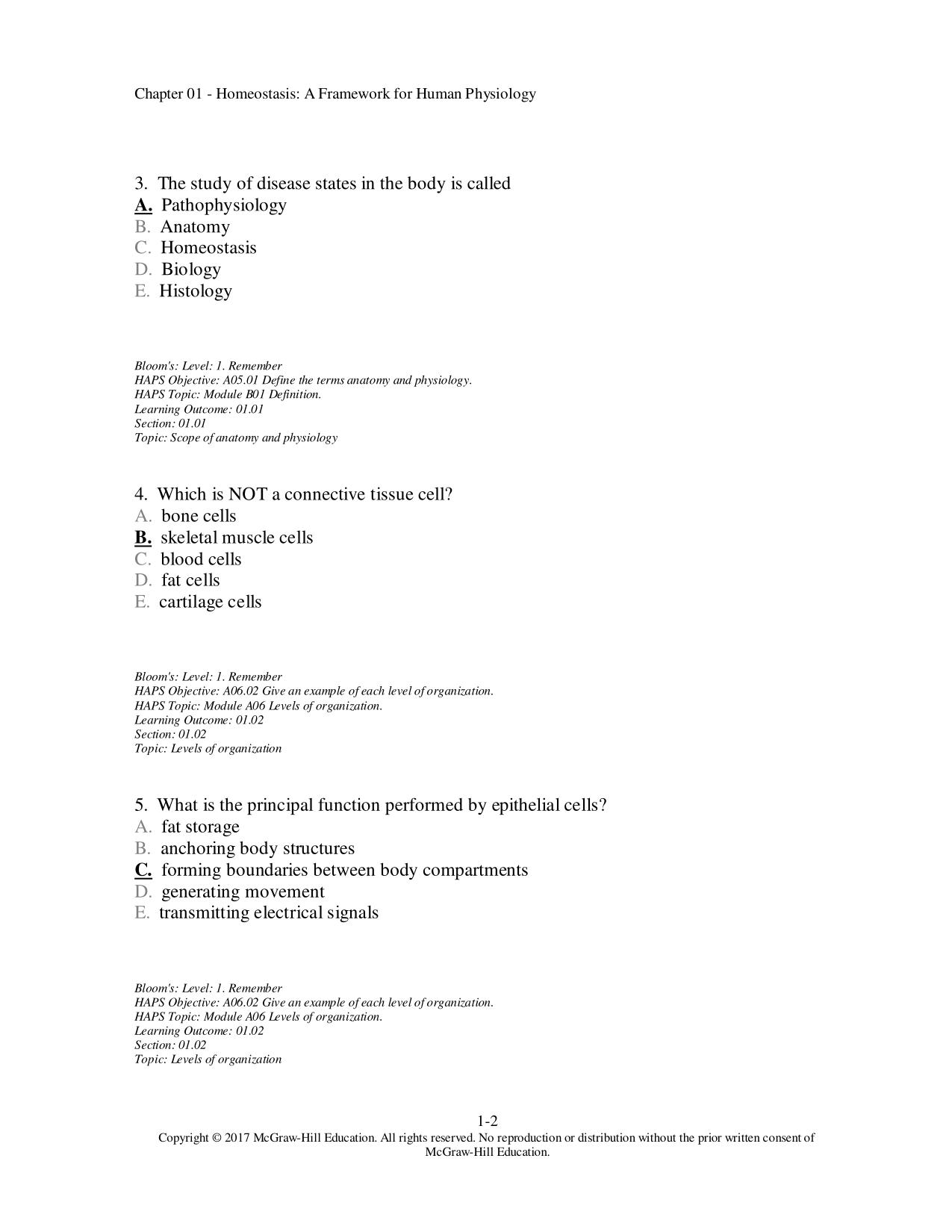
Chapter 01 - Homeostasis: A Framework for Human Physiology Chapter 01 Homeostasis: A Framework for Human Physiology Multiple Choice Questions 1. Which of these is NOT one of the four general categories of cells that make up the human body? A. epithelial cells B. collagen cells C. connective tissue cell D. neuron E. muscle cell Bloom's: Level: 1. Remember HAPS Objective: A06.01 Describe, in order from simplest to most complex, the major levels of organization in the human organi sm. HAPS Topic: Module A06 Levels of organization. Learning Outcome: 01.02 Section: 01.02 Topic: Levels of organization 2. Physiology is the study of A. How two organisms interact B. How organisms function C. The spread of diseases D. The structure of the body Bloom's: Level: 1. Remember HAPS Objective: A05.01 Define the terms anatomy and physiology. HAPS Topic: Module B01 Definition. Learning Outcome: 01.01 Section: 01.01 Topic: Scope of anatomy and physiology 1-1 Copyright © 2017 McGraw-Hill Education. All rights reserved. No reproduction or distribution without the prior written consent of McGraw-Hill Education. Chapter 01 - Homeostasis: A Framework for Human Physiology 3. The study of disease states in the body is called A. Pathophysiology B. Anatomy C. Homeostasis D. Biology E. Histology Bloom's: Level: 1. Remember HAPS Objective: A05.01 Define the terms anatomy and physiology. HAPS Topic: Module B01 Definition. Learning Outcome: 01.01 Section: 01.01 Topic: Scope of anatomy and physiology 4. Which is NOT a connective tissue cell? A. bone cells B. skeletal muscle cells C. blood cells D. fat cells E. cartilage cells Bloom's: Level: 1. Remember HAPS Objective: A06.02 Give an example of each level of organization. HAPS Topic: Module A06 Levels of organization. Learning Outcome: 01.02 Section: 01.02 Topic: Levels of organization 5. What is the principal function performed by epithelial cells? A. fat storage B. anchoring body structures C. forming boundaries between body compartments D. generating movement E. transmitting electrical signals Bloom's: Level: 1. Remember HAPS Objective: A06.02 Give an example of each level of organization. HAPS Topic: Module A06 Levels of organization. Learning Outcome: 01.02 Section: 01.02 Topic: Levels of organization 1-2 Copyright © 2017 McGraw-Hill Education. All rights reserved. No reproduction or distribution without the prior written consent of McGraw-Hill Education. Chapter 01 - Homeostasis: A Framework for Human Physiology 6. The cell type that is specialized to communicate with other cells and control their activities is A. Epithelial cells B. Muscle cells C. Connective tissue cells D. Nerve cells Bloom's: Level: 1. Remember HAPS Objective: A06.02 Give an example of each level of organization. HAPS Topic: Module A06 Levels of organization. Learning Outcome: 01.02 Section: 01.02 Topic: Levels of organization 7. What is the term for the developmental process that leads to specialized cell types? A. genomics B. differentiation C. homeostasis D. positive feedback E. acclimatization Bloom's: Level: 1. Remember HAPS Objective: A06.01 Describe, in order from simplest to most complex, the major levels of organization in the human organism. HAPS Topic: Module A06 Levels of organization. Learning Outcome: 01.02 Section: 01.02 Topic: Levels of organization 1-3 Copyright © 2017 McGraw-Hill Education. All rights reserved. No reproduction or distribution without the prior written consent of McGraw-Hill Education. Chapter 01 - Homeostasis: A Framework for Human Physiology 8. Which best describes the extracellular matrix? A. It is found just inside the cell membrane in all tissues, it sends branching collagen fibers between cells to connect them, and it transmits chemical information from the interior of one cell to the interior of adjacent cells. B. It is a tissue having more than the four general cell types, it transports proteins and polysaccharides between body compartments, and it is the route by which chemical signals like hormones reach all parts of the body. C. It covers the body's surface, it contains connective and muscle tissue, and it helps generate movement. D. It surrounds cells; it contains proteins, polysaccharides, and minerals; it provides a scaffold for cell attachment; and it transmits chemical messengers to cells. Bloom's: Level: 2. Understand HAPS Objective: A06.02 Give an example of each level of organization. HAPS Topic: Module A06 Levels of organization. Learning Outcome: 01.02 Section: 01.02 Topic: Levels of organization 9. If a person begins to sweat upon entering a hot room but continued sweating is able to keep the body temperature constant, which of these best describes her condition? A. She is in an equilibrium state. B. She is not using energy to maintain a constant temperature. C. She is in a steady state D. She is using a positive feedback mechanism. Bloom's: Level: 2. Understand HAPS Objective: B01.01 Define homeostasis. HAPS Objective: B04.01 Provide specific examples to demonstrate how organ systems respond to maintain homeostasis. HAPS Topic: Module B03 Examples of homeostatic mechanisms. Learning Outcome: 01.05 Section: 01.05 Topic: Examples of homeostatic mechanisms 1-4 Copyright © 2017 McGraw-Hill Education. All rights reserved. No reproduction or distribution without the prior written consent of McGraw-Hill Education.
CourseHero & Studypool Unlocks
Get Unlocked CourseHero and Studypool documents files instantly to your email, simply by pasting your link and clicking "Unlock Now". Learn more on how to unlock here.


Gradesity

We are here to help
Questions? Leave a message!
Newsletter
Get notified upon new uploads. Subscribe to our Newsletter.