LETRS Unit 1 Assessment 2025/2026 Update Questions and Solutions
Course:
LETRS
Institution:
LETRS
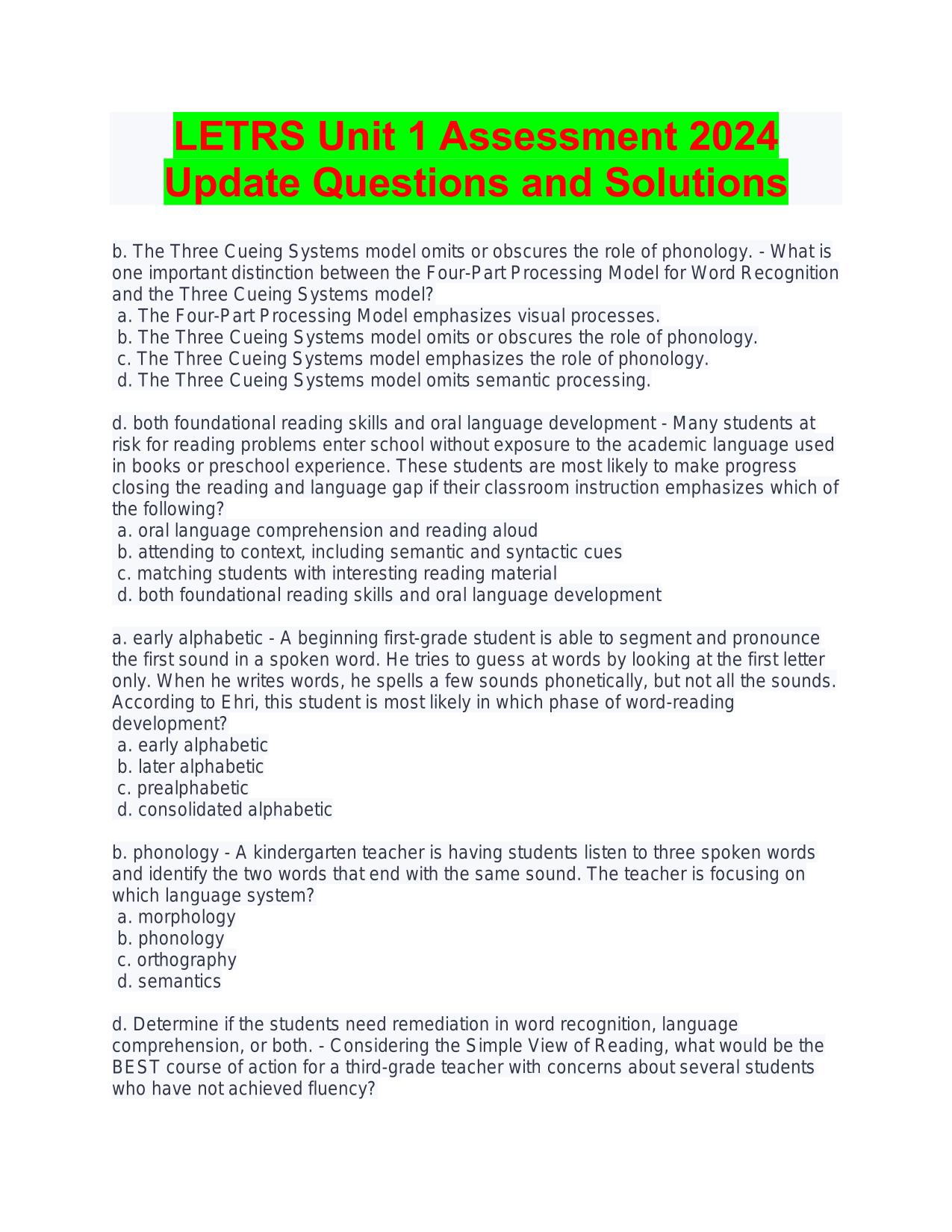
LETRS Unit 1 Assessment 2024 Update Questions and Solutions b. The Three Cueing Systems model omits or obscures the role of phonology. - What is one important distinction between the Four-Part Processing Model for Word Recognition and the Three Cuein...
After purchase, you get:
✅ Instant PDF Download
✅ Verified answer explanations
✅ Refund if not Satisfied
✅ Prepared for 2025/2026 test cycle
Overview
Questions are arranged to build from basic concepts to more advanced challenges, making the learning curve smoother and more organized. You'll notice your certainty growing naturally as you learn thoroughly each level before moving to the next. This scaffolding approach prevents that overwhelmed feeling that often comes with jumping into complex topics too quickly. Many learners appreciate how this progression mirrors the way we naturally learn - building step by step from simple to sophisticated. Through its methodical structure and clear reasoning, LETRS Unit 1 Assessment 2025/2026 Update Questions and Solutions gives learners a strategic advantage for the LETRS Unit 1 Assessment / Update and Solutions exam. The systematic approach ensures you develop both depth of knowledge and exam-specific skills. Many users find they're able to achieve scores they didn't think possible before discovering this resource. The complete preparation builds a foundation for success that extends beyond just passing the test.
Who Is This For?
Designed for motivated learners working toward certification, licensure, or degree completion within the LETRS track. People appreciate how it keeps them organized during stressful preparation periods. The systematic approach helps maintain study momentum.
Related Keywords
Detailed Study Description
Frequently Asked Questions
Document Information
| Uploaded on: | November 1, 2025 |
| Last updated: | November 17, 2025 |
| Number of pages: | 3 |
| Written in: | 2025/2026 |
| Type: | Exam (elaborations) |
| Contains: | Questions & Answers |
| Tags: | LETRS Unit 1 Assessment 2024 Update Questions and Solutions b. The Three Cueing Systems model omits or obscures the role of phonology. - What is one important distinction between the Four-Part Processing Model for Word Recognition and the Three Cueing Systems model? a. The Four-Part Processing Model emphasizes visual processes. b. The Three Cueing Systems model omits or obscures the role of phonology. c. The Three Cueing Systems model emphasizes the role of phonology. d. The Three Cueing Systems model omits semantic processing. d. both foundational reading skills and oral language development - Many students at risk for reading problems enter school without exposure to the academic language used in books or preschool experience. These students are most likely to make progress closing the reading and language gap if their classroom instruction emphasizes which of the following? a. oral language comprehension and reading aloud b. attending to context, including semantic and syntactic cues c. matching students with interesting reading material d. both foundational reading skills and oral language development a. early alphabetic - A beginning first-grade student is able to segment and pronounce the first sound in a spoken word. He tries to guess at words by looking at the first letter only. When he writes words, he spells a few sounds |
Seller Information

AdelineJean
User Reviews (0)
Exam (Elaborations)
$5.50
Add to Cart
100% satisfaction guarantee
Refund Upon dissatisfaction
Immediately available after purchase
Available in Both online and PDF
$5.50
| 0 sold
Discover More resources
Inside The Document
LETRS Unit 1 Assessment 2024 Update Questions and Solutions b. The Three Cueing Systems model omits or obscures the role of phonology. - What is one important distinction between the Four-Part Processing Model for Word Recognition and the Three Cueing Systems model? a. The Four-Part Processing Model emphasizes visual processes. b. The Three Cueing Systems model omits or obscures the role of phonology. c. The Three Cueing Systems model emphasizes the role of phonology. d. The Three Cueing Systems model omits semantic processing. d. both foundational reading skills and oral language development - Many students at risk for reading problems enter school without exposure to the academic language used in books or preschool experience. These students are most likely to make progress closing the reading and language gap if their classroom instruction emphasizes which of the following? a. oral language comprehension and reading aloud b. attending to context, including semantic and syntactic cues c. matching students with interesting reading material d. both foundational reading skills and oral language development a. early alphabetic - A beginning first-grade student is able to segment and pronounce the first sound in a spoken word. He tries to guess at words by looking at the first letter only. When he writes words, he spells a few sounds phonetically, but not all the sounds. According to Ehri, this student is most likely in which phase of word-reading development? a. early alphabetic b. later alphabetic c. prealphabetic d. consolidated alphabetic b. phonology - A kindergarten teacher is having students listen to three spoken words and identify the two words that end with the same sound. The teacher is focusing on which language system? a. morphology b. phonology c. orthography d. semantics d. Determine if the students need remediation in word recognition, language comprehension, or both. - Considering the Simple View of Reading, what would be the BEST course of action for a third-grade teacher with concerns about several students who have not achieved fluency?
CourseHero & Studypool Unlocks
Get Unlocked CourseHero and Studypool documents files instantly to your email, simply by pasting your link and clicking "Unlock Now". Learn more on how to unlock here.

Gradesity

We are here to help
Questions? Leave a message!
Newsletter
Get notified upon new uploads. Subscribe to our Newsletter.