BSN205 HALLMARK- VITAL SIGNS ISB ACTUAL 2025/2026 QUESTIONS AND 100% CORRECT ANSWERS
Course:
BSN205
Institution:
BSN205
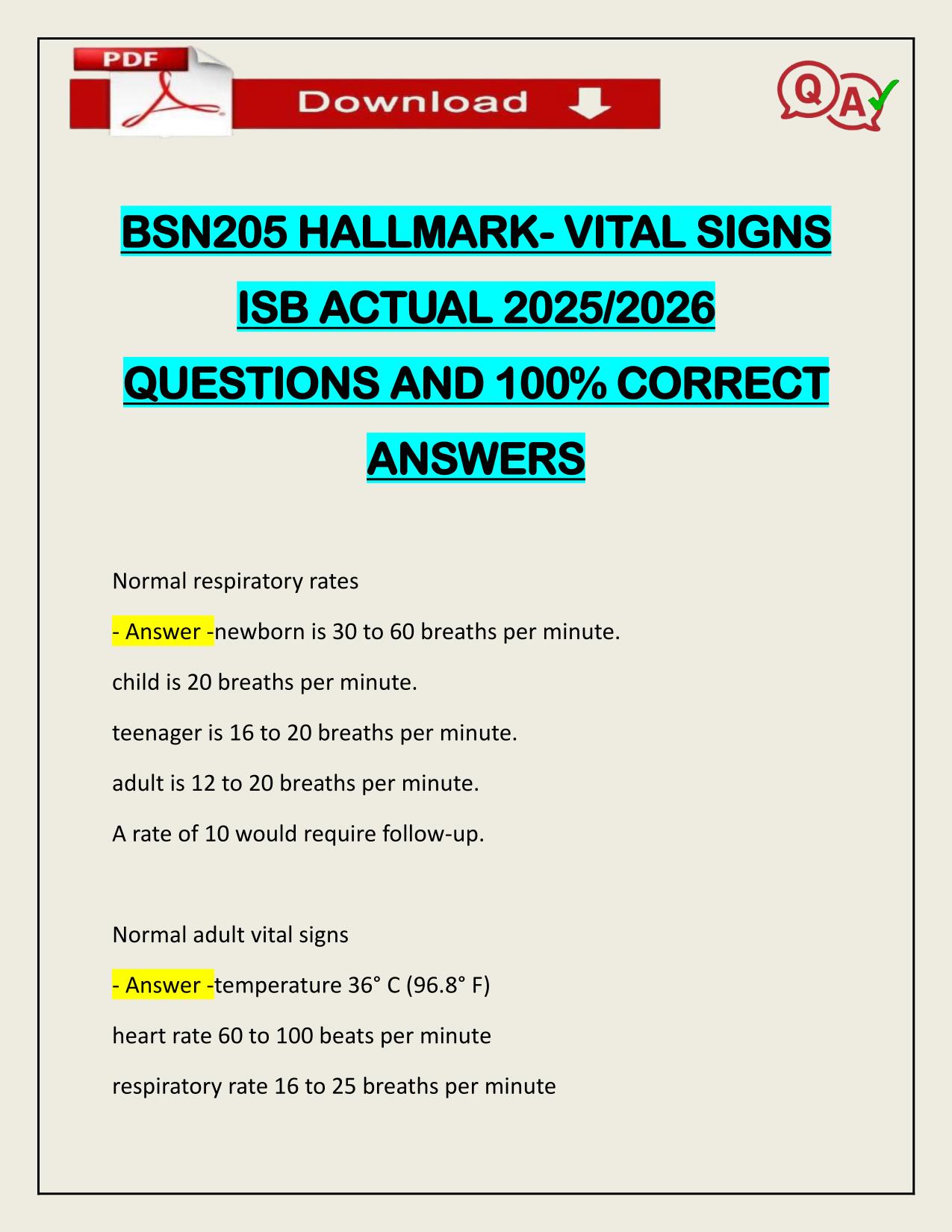
BSN205 HALLMARK- VITAL SIGNS ISB ACTUAL 2025/2026 QUESTIONS AND 100% CORRECT ANSWERS Normal respiratory rates - Answer -newborn is 30 to 60 breaths per minute. child is 20 breaths per minute. teenager is 16 to 20 breaths per minute. adult is 12 to 20...
After purchase, you get:
✅ Instant PDF Download
✅ Verified answer explanations
✅ Refund if not Satisfied
✅ Prepared for 2025/2026 test cycle
Overview
The content structure supports both short revision sessions and long, dedicated study periods. Whether you have 15 minutes between classes or several hours on the weekend, the material adapts to your schedule. This flexibility is perfect for students with busy, unpredictable lives. Many learners appreciate being able to make progress regardless of how much time they have available. The scenarios included in BSN205 HALLMARK- VITAL SIGNS ISB ACTUAL 2025/2026 QUESTIONS AND 100% CORRECT ANSWERS encourage critical thinking and reinforce practical application of BSN205 principles. Rather than just memorizing facts, you'll practice applying knowledge in realistic situations. This approach transforms abstract concepts into tangible skills you can actually use. Students often notice they're better able to recall information during exams because they've practiced using it in context.
Who Is This For?
A helpful guide for individuals needing methodical repetition and progressive question difficulty tied to BSN205 HALLMARK- VITAL SIGNS ISB ACTUAL / AND 100% CORRECT learning goals. Many users appreciate how it gradually increases challenge levels. The building-block approach supports sustainable learning progress. Developed for learners who prefer self-paced preparation with easy-to-follow explanations rooted in real exam formats. People appreciate being able to study at their own speed. The material builds naturally from basic concepts to more advanced applications.
Related Keywords
Detailed Study Description
Frequently Asked Questions
Document Information
| Uploaded on: | October 26, 2025 |
| Last updated: | November 17, 2025 |
| Number of pages: | 23 |
| Written in: | 2025/2026 |
| Type: | Exam (elaborations) |
| Contains: | Questions & Answers |
| Tags: | BSN205 HALLMARK- VITAL SIGNS ISB ACTUAL 2025/2026 QUESTIONS AND 100% CORRECT ANSWERS Normal respiratory rates - Answer -newborn is 30 to 60 breaths per minute. child is 20 breaths per minute. teenager is 16 to 20 breaths per minute. adult is 12 to 20 breaths per minute. A rate of 10 would require follow-up. |
Seller Information

AdelineJean
User Reviews (0)
Exam (Elaborations)
$9.50
Add to Cart
100% satisfaction guarantee
Refund Upon dissatisfaction
Immediately available after purchase
Available in Both online and PDF
$9.50
| 0 sold
Discover More resources


Inside The Document
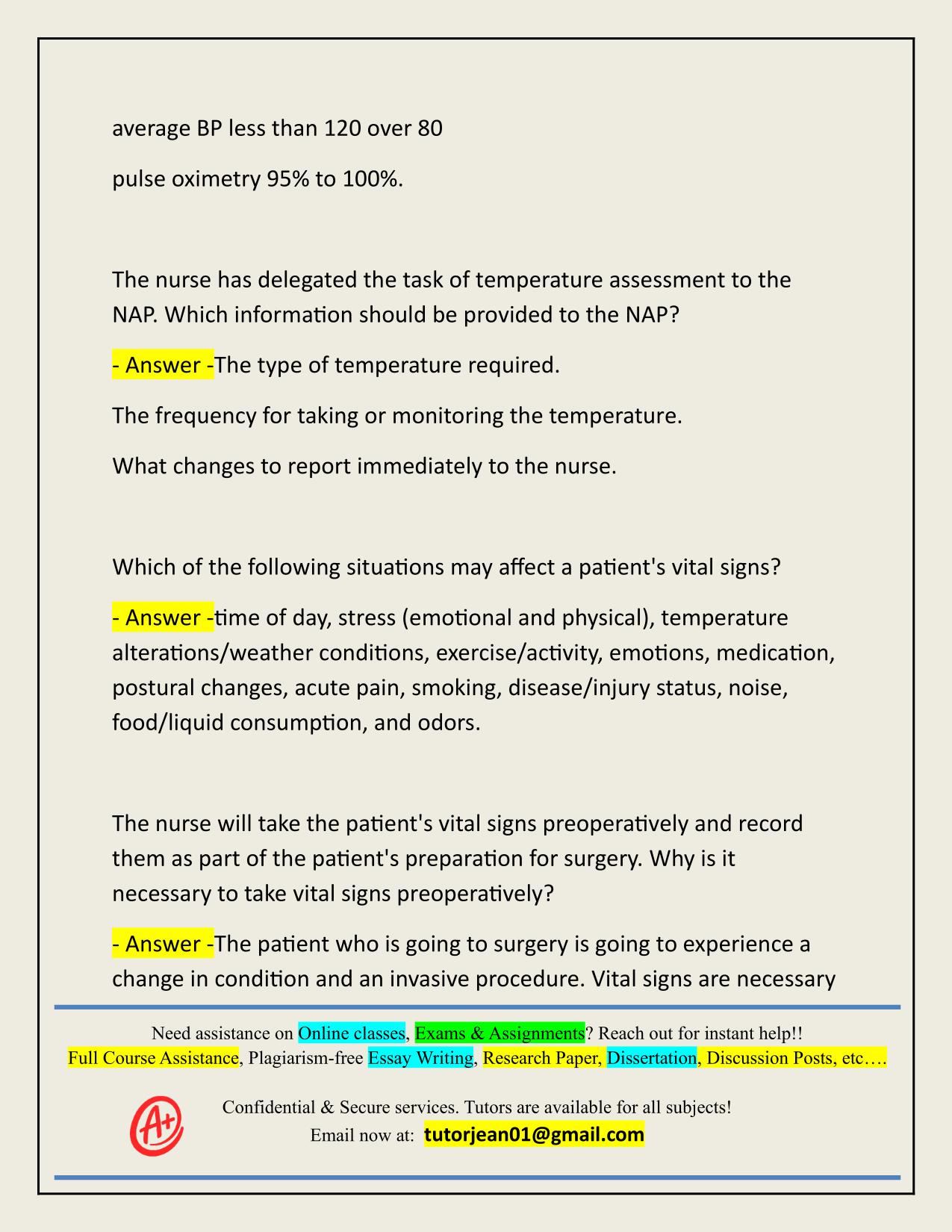
BSN205 HALLMARK- VITAL SIGNS ISB ACTUAL 2025/2026 QUESTIONS AND 100% CORRECT ANSWERS Normal respiratory rates - Answer -newborn is 30 to 60 breaths per minute. child is 20 breaths per minute. teenager is 16 to 20 breaths per minute. adult is 12 to 20 breaths per minute. A rate of 10 would require follow-up. Normal adult vital signs - Answer -temperature 36° C (96.8° F) heart rate 60 to 100 beats per minute respiratory rate 16 to 25 breaths per minute average BP less than 120 over 80 pulse oximetry 95% to 100%. The nurse has delegated the task of temperature assessment to the NAP. Which information should be provided to the NAP? - Answer -The type of temperature required. The frequency for taking or monitoring the temperature. What changes to report immediately to the nurse. Which of the following situations may affect a patient's vital signs? - Answer -time of day, stress (emotional and physical), temperature alterations/weather conditions, exercise/activity, emotions, medication, postural changes, acute pain, smoking, disease/injury status, noise, food/liquid consumption, and odors. The nurse will take the patient's vital signs preoperatively and record them as part of the patient's preparation for surgery. Why is it necessary to take vital signs preoperatively? - Answer -The patient who is going to surgery is going to experience a change in condition and an invasive procedure. Vital signs are necessary Need assistance on Online classes, Exams & Assignments? Reach out for instant help!! Full Course Assistance, Plagiarism-free Essay Writing, Research Paper, Dissertation, Discussion Posts, etc…. Confidential & Secure services. Tutors are available for all subjects! Email now at: tutorjean01@gmail.com so that the operative team has a baseline for comparison as well as to rule out any complications before the beginning of the surgical event. Providing reassurance to the patient can be done verbally. If a patient reports feeling different, assessing vital signs is appropriate. There is no indication the patient is feeling different. Equipment should be maintained in a functional state at all times. The NAP reports to the nurse a 65-year-old patient s blood pressure is 160/98. What is the appropriate initial response of the nurse? - Answer -This is out of normal range. If there is a question regarding a patient's vital signs or a suspected change in the patient's condition that may require further assessment, the nurse should take the patient's vital signs rather than delegating the task. Which patient would it be appropriate for the nurse to delegate vital signs? - Answer -The nurse may delegate routine vital signs of stable patients. Obtaining a baseline upon admission or transfer patient should be completed by the nurse. If a patient has a change in condition, such as a headache which could be reflective of hypertension, the nurse should assess the patient's vital signs. Which person would be expected to have the lowest body temperature? - Answer -The 80 year old would have the lower starting body temp. The NAP is preparing to measure a patient's vital signs. The patient reports having eaten a bowl of warm soup. The NAP asks the RN what he should do. What is the best response? - Answer -The temperature of food or liquid could impair the accuracy of the reading. The NAP should ask the patient not to eat, drink, or smoke for 20 minutes and then assess the oral temperature. Taking a rectal temperature can be needlessly embarrassing and uncomfortable for the patient. Although the axillary route could be used, it is less accurate than the oral route. Furthermore, when recording an axillary temperature reading, the site is documented, but the reading itself is unchanged. For which patient would a tympanic thermometer be the preferred thermometer to use? - Answer -An advantage to the tympanic thermometer is that it can be used for tachypneic patients. The tympanic thermometer is contraindicated in patients who have had surgery of the ear or tympanic membrane and does not accurately measure core temperature after exercise. A continuous measurement Need assistance on Online classes, Exams & Assignments? Reach out for instant help!! Full Course Assistance, Plagiarism-free Essay Writing, Research Paper, Dissertation, Discussion Posts, etc…. Confidential & Secure services. Tutors are available for all subjects! Email now at: tutorjean01@gmail.com
CourseHero & Studypool Unlocks
Get Unlocked CourseHero and Studypool documents files instantly to your email, simply by pasting your link and clicking "Unlock Now". Learn more on how to unlock here.

Gradesity

We are here to help
Questions? Leave a message!
Newsletter
Get notified upon new uploads. Subscribe to our Newsletter.